Draw Date: October 4, 2018.
The winner can win up to $20,000 if all the tickets are sold!
–
More details and to purchase a ticket, click HERE

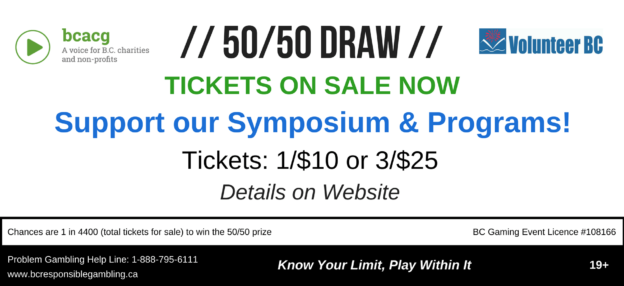
Draw Date: October 4, 2018.
The winner can win up to $20,000 if all the tickets are sold!
–
More details and to purchase a ticket, click HERE

NEWS ABOUT STAFF CHANGES
As the 2018 season opens we’re getting your calls and emails about the new year’s grant applications. I’m appreciating hearing stories of your successes and for some, of frustration and a determination to make a better application. I’m writing to tell you that I’ve accepted a new opportunity to do important work in housing and community building. I’ve given my notice effective February 28 and will be starting a new position as Manager, Non Profit Portfolio with BC Housing in Prince George. I am looking forward to this new chapter and am especially intrigued to work in northern BC.
I’ve been with the BCACG since October 2013 and it has been a pleasure to work with you and on behalf of the non-profit sector in British Columbia. I’ve been able to get to know many of you and enjoyed talking with you about your programming and how to prepare a more effective Gaming Grant Application. I’ve especially enjoyed doing the training workshops and note that one of our successes is a strong commitment from the Gaming Branch to training and outreach with a recognition that this is a complex application. I have also had numerous conversations with the Gaming Branch and developed a deeper understanding of their perspective, including the constraints inherent in administering such a Grant. Certainly greater mutual understanding (and more capacity) will make the Gaming Grant more relevant to sustainable communities in towns throughout the province. And of course, apply continued pressure with the Branch and with your MLA about how you use the Gaming Grant to make your community stronger and healthier – convey the impact of the work you do. This is a core reason why the Gaming Grant is important and why it has an obligation to community programming.
The Board has posted for the Executive Director position. Information is in the News section of www.bcacg.com and will be circulated through our and other networks. The posting is on CharityVillage.com. Spread the word about a great opportunity for an adult educator, government relations and community development character who has a background in the Gaming Grant. It would be an advantage to know the history of attachment between Gaming Grants and the Community and to have extensive experience in non-profit operations. The location of work is negotiable. The position works from a virtual office. Travel in the province is substantial and proximity to Victoria and Metro Vancouver is an advantage.
GUIDELINES AMENDED 2018
The Gaming Grant Guidelines have been amended as of February 1, 2018. The current version is available here https://www2.gov.bc.ca/assets/gov/sports-recreation-arts-and-culture/gambling/grants/guide-cgg.pdf
There are a few changes worth noting:
HOW TO WRITE THE PROGRAM DESCRIPTION
Section 4.1 of the Guidelines says that program eligibility is measured on four points: has operated for 12 months, demonstrates community benefit, is accessible and inclusive, and has a sustainability plan. Focus the Program Description on these four points. At the end, add a fifth point about how the funds will be used – the Describe in Detail section of the Application where you’ll talk about key things that you see coming up in the next year – and summarize your financial ask. The Analysts read several hundred applications per year and many each day. Keep your program description tight and focussed to the four items stated in the Guidelines. Click here for full details.
FREE COMMUNITY GAMING GRANT WORKSHOP @ RICHMOND
Topic: Community Gaming Grant Workshop
Date: Friday, February 23, 2018
Time: 9:00 am – 12 pm
Location, Richmond Caring Place – Room 340.
Cost: Free
Limited seating. Book your seat early to avoid disappointment!
The Fraser Valley Community Charitable Gaming Association (FVCCGA) is a non-profit society that supports community groups applying for a Community Gaming Grant.
Our workshops review the eligibility requirements, program description and details, budget, in-kind support, volunteers and key considerations when accounting for activities.
Hear about new updates to the Guidelines and join us for an interactive session with community groups with opportunity to ask questions and get feedback on your programming.
About the facilitator:
David Sheach is the Facilitator for the FVCCGA and is Executive Director of the BC Association for Charitable Gaming. He is presenting a three hour Gaming Grant workshop to help you prepare an accurate application and manage the funding according to the conditions of the grant.
For more information email: executivedirector.bcacg@gmail.com
Section 4.1 of the Guidelines says that program eligibility is measured on four points: has operated for 12 months, demonstrates community benefit, is accessible and inclusive, and has a sustainability plan. Focus the Program Description on these four points. At the end, add a fifth point about how the funds will be used – the Describe in Detail section of the Application where you’ll talk about key things that you see coming up in the next year – and summarize your financial ask. The Analysts read several hundred applications per year and many each day. Keep your program description tight and focussed to the four items stated in the Guidelines.
1. Pre-Amble – The program must have been operating for a minimum of 12 months.
Use this section to write a paragraph or two. Talk some about the background to the program. In the Application it will ask how long the program has operated, in years and months. Give some information about what happened in the last twelve months and talk a bit about what stood out in the year, maybe things that need to be addressed going forward or trends that are showing which may have an impact on future direction. Make sure you focus on the Program and not on the Organization. Keep it short but its here too that you might tell the history, purpose or vision of the Program.
Avoid talking about what you are going to do and about the broader vision and activities of your Organization. Focus on what you have been doing and in a foreshadowing kind of way, on what is noteworthy in the last year.
2. Community Benefit – Convey the Impact of the Work that You Do.
Even if this is a first application, the program has history of at least 12 months. Reflect on the work you’ve done in your program description. If you’ve already been receiving Gaming funding, tell them what happened in comparison to what you proposed. At this stage you’ve been operating for 12-24 months or more and you have some data that you can share and which demonstrates what you’re doing and who you are serving. Use this section to reflect on the services provided and programming delivered. Talk about what happened in the last twelve months. Convey Impact. Gaming wants to see your numbers; the outputs of the program. How many of what did you do and how often; with whom; where? Use a table or a pie chart or a bar graph to give a visual; include a photo or a link Compare year over year or provide a three or five year overview if you can. If you haven’t collected information in this way, talk about what you know. Sit down with your people and get some basic information to include. After that, start to collect information this year – easy stuff; stuff that makes sense to you, your organization and the program. The data you collect doesn’t need to be complex and it ought to be relevant for the organization.
Highlight trends or the things you are noticing – growth, shifts in clientele or services, shifts in demand or emerging items. Talk about some of the successes, provide anecdotal highlights of key outcomes. Include, where you can, quotes from people affected – sprinkle these throughout your Description. Often times you’ll have a card or an email where a participant talks about how the Program affected them or their family. Clip from these and insert them in the text to prove your statements or add them as a pull out text box to draw the reader to the key points.
3. Accessible and Inclusive – Grant recipients and their programming needs to reflect Provincial values.
At minimum, this section is your diversity statement. The core issue is that the Province won’t fund an organization that doesn’t reflect the values of the Province of BC.
Gaming expects that programming that is funded with a Gaming Grant is as open and inclusive as possible but they also don’t expect the organization to change its programming. They do expect that the programming is accessible and without discrimination against any group, so for instance if you are Big Sisters you don’t have to serve boys too but you do need to ensure that you serve girls without barriers, likewise if you are a senior’s centre, it’s not that you need to serve young or middle age people, but you need to be open to all seniors. Talk about the accommodations that you make to be inclusive – physical accessibility, cultural outreach, etc.
In many cases organizations and programs are particularly oriented around these values and that makes this section an important place to talk about what you do. If you are the White Cane society then you will talk at some length about creating accessibility for people with a lending library, adaptive equipment, public awareness campaigns or social gatherings, emotional supports for people, referral services or community partnerships.
4. Sustainability
Each program needs to have a minimum of 25% funding from sources other than the federal or provincial government. Appendix IV has a partial list of what is included as provincial and federal funding. These are government administered programs, grants or donations from crown corporations and money from school districts or health authorities. Cities, towns, regional districts and indigenous governments, for the sake of this grant, count as local or community money.
If you have your own money, ie fundraising money, include it here too. Talk about the raffle, golf tournament or major gifts program that you have and the donors that are contributing to the program. This shows up as revenue in the income statement and budget. The time that you invest to raise that money doesn’t count toward the volunteer time – that time got converted into the cash from the activity. The organization can invest some or all of that cash into the program, alongside the money requested from Gaming and other sources.
Include your volunteers here. Talk about how many volunteers you have, how much time they invest and the kinds of work that they do in the program. Volunteers can be valued at up to $20/hour. If you pay your staff less, for the same job, you may choose to value your volunteers at the same rate, for the same job. If you decide to do that, make sure you calculate the full cost of your staff, ie add the mandatory employment related costs plus any other benefits and vacation pay that is included, so you have an accurate value – not just the rack rate of $X per hour. If your volunteer does a different job, ie has a separate job description, then you could consider valuing them at a different/higher rate.
New applications need to have letters of support but its a helpful idea to collect letters and notes of support on an ongoing basis. The strongest letters come from other supporters, for example:
Another funder, a local business supporter or a donor or another organization that funds the program. Their letter might say something like, “Of all the people that ask for my time or money, I choose this organization because I think it best reflects my values, best reflects the values of my customers and in my observation has an impact that I appreciate.”
A participant, a parent or a front line beneficiary of the program. Their letter might talk about how they feel, how the program has changed their life, feelings or opportunities; about their first-hand experience with the program.
A volunteer who talks about the returns they see from volunteering in this program, how it affects them and why they choose this program to invest their volunteer time; about their observations about the program’s impact on the community and its participants.
All of these are other investors and beneficiaries that are talking directly to Gaming about why they invest and how they are affected – and inviting Gaming to invest along with them.
This section isn’t about proving that you won’t need money one day, it is about who else in your neighbourhood is involved in your program and organization, your networks and other funders that help ensure that your program will have lasting impact.
5. Describe in Detail
On the Application form there is a section that immediately follows the Program Description and its not mentioned in the Guidelines or training. It asks that you provide summary details about how the funds will be used. The section isn’t meant to have a complex answer and this is the place where the Analyst goes for a quick reminder of your request. In short, they want a list – we want $X and we’re going to spend $Y on this and $Z on that and two more items – short and simple, for example, requesting $15,000 and spending $8,000 on rent, $2,000 on program liability insurance with $4000 for staffing and $1000 for program materials.
This section is the place to begin to talk about the year going forward. As your story unfolded – the last 12 months of operation, the benefits to community, accessible and inclusive and sustainable – it revealed what is needed for a successful next year. If you were reporting growth and your stats show “measured un-met demand”, then in the next year, you’re going to talk about how to respond. It may be that you have a case for additional funding and you’re going to talk about that here. Or you may need to emphasize certain things in this year’s work – in communications, or systems, or shifting some activities in order to respond to participant requests or changing interests.
Summary
The Pre-amble in part one will set up the story by talking about the trends, highlights and observations from the last year. Community Benefit will prove your case, not only by talking about the numbers but these will also show where there is notable shift – in growth or evolution of your program and clientele. Accessible and Inclusive may add to the story but they demonstrate your organization’s values and efforts to reach and be relevant to people in your community. Sustainability is the core of your case for support because it talks about your other partners and investors – those others who believe in your programming who have been convinced by your story. Describe in Detail piece is, like Dragnet would say, “Just the facts”…but also opens the door to next year’s work.
Important Reminder:
The Community Gaming Grants program distributes $5 million per year to eligible not-for-profit organizations to assist with capital projects with a total cost of more than $20,000. Eligible not-for-profit organizations may be approved for up to 50% of the total cost of the project, to a maximum of $250,000.
Organizations wishing to apply for a Capital Project Grant are reminded that they have until September 30 to submit their application.
1) How will the applications evaluated?
An organization must demonstrate on its application that it meets the mandatory eligibility criteria. Each application that meets eligibility criteria will then be scored based on how well the proposed project meets the following assessment criteria: Financial Considerations, Project Feasibility,Alignment with Sector Objectives and Special Project Features
Additional consideration will be given to the allocation of grant funding across the six Community Gaming Grant sectors, the geographic distribution of grants throughout the province, project size and the inclusion of Aboriginal not-for-profit organizations.
2) Is there a time limit for how long an organization has to complete the project?
Yes. The project must be completed, and the grant funds spent, within 36 months of receipt of the grant.
3) Do applicants need to contribute their own money to the project?
Yes. Organizations are expected to provide matching funds. In addition to cash, this can include tangible in-kind contributions, such as donated equipment and materials. Land and intangible in-kind support, such as volunteer time, donated labour or services will not be accepted as matching funds.
4) Does an organization need to own the land on which it plans to complete the project?
No. An organization does not need to own the land provided it has a long-term lease agreement with the landowner or some other equivalent arrangement, has their written permission to undertake the project, and is responsible for maintaining the facility after it is completed.
5) What is the purpose of the risk management plan, and what needs to be in it?
In the risk management plan, applicants must identify and rank potential risks as either high, medium or low based on likelihood and consequence, and then identify proposed management/mitigation strategies. The risk management plan can be prepared by anyone knowledgeable of the project. It can be a simple list of possible risks and how they can be minimized. The risk management plan is not required to be an additional eligible expense though it can be.
Interested in applying for the Capital Projects Grant? See the Capital Projects Grants web page for more information on this program and be sure to get your application in by the September 30 deadline.
Successful applicants will be notified via email.
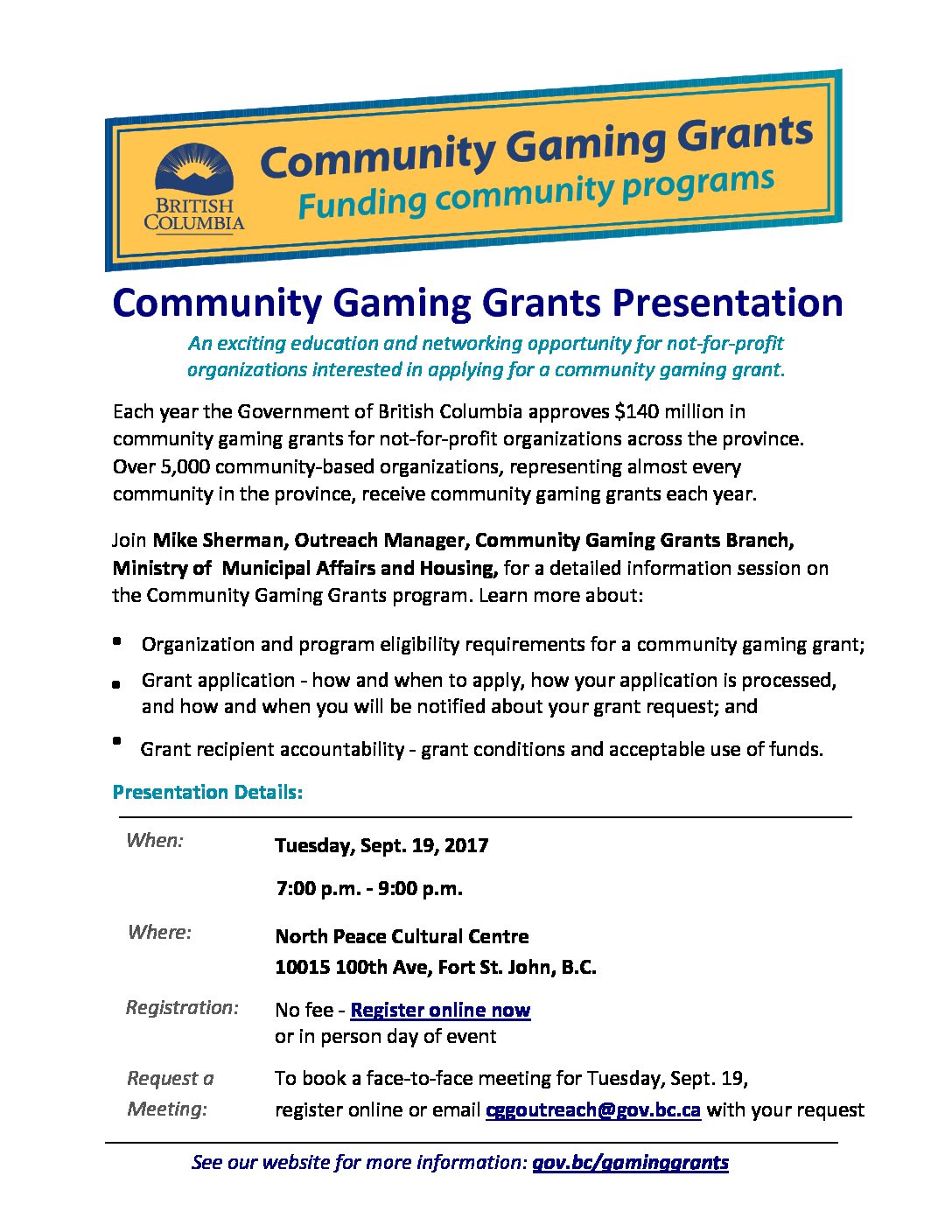
You are invited to the B.C. Government’s Community Gaming Grant Presentation for the Northeast Region on Tuesday September 19th 7pm-9pm at the North Peace Cultural Centre in Fort St. John.
Join Mike Sherman, Outreach Manager, Community Gaming Grants Branch, Ministry of Municipal Affairs and Housing, for a detailed information session on the Community Gaming Grants program. This is an exciting education and networking opportunity for any not-for-profit organization interested in applying for a Community Gaming Grant. Please see the attached invitation for more information and links to register online .
Thank you and we look forward to seeing you there!
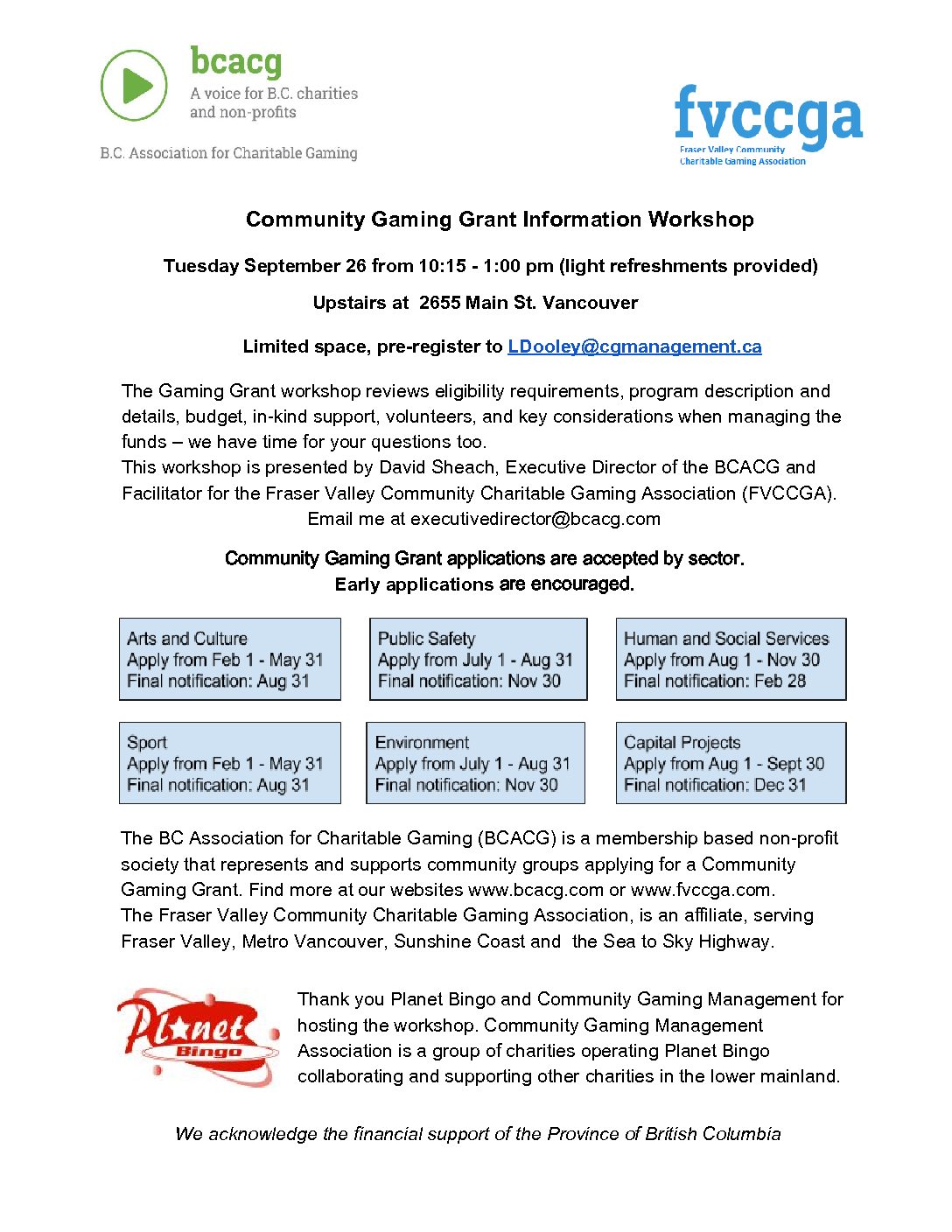
Community Gaming Grant Workshop
When: September 26
Where: 1015-1 at 2655 Main St. Vancouver
For more details click here.
While section 7.6 of the Guidelines indicates that conferences are a prohibited use of Gaming funds, the Community Gaming Grants Branch recognizes that the 2017 Volunteer Futures Symposium is an important source of current information about the Community Gaming Grant. Likewise volunteer training, related to the direct delivery of your approved program, is an eligible Gaming Grant expense (see point 7c of Appendix VIII, Conditions of the Community Gaming Grant).
As they have in previous years, Gaming is allowing organizations to use gaming funds to attend the Symposium. As with any use of funds, organizations are expected to demonstrate how the training contributes to program delivery.
Travel expenses for volunteers to go to the BCACG Symposium are eligible to be paid from an organization’s gaming account. An additional $500 that may also be allocated from the gaming account. It is to be used in any manner directly related to the BCACG Symposium. For example, a paid employee of an organization may use the $500 towards travel and accommodation and/or any registration fees related to the Symposium.
Please contact David Sheach at executivedirector@bcacg.com if you have any questions.
The Capital Projects Grants webinar is on Tuesday, August 1 has now been posted to our website. Feel free to share the registration link with your networks.
All published information on this grant is in the capital projects section on the website: http://www2.gov.bc.ca/gov/content/sports-culture/gambling-fundraising/gaming-grants/capital-project-grants
The webinar will include an overview of applicant and project eligibility, assessment criteria and the online application process. Attendees will also have the chance to ask questions and participate in the discussion.
Date: Tuesday, August 1, 2017
Time: 1:30 p.m – 3:00 p.m.
Place: Online
How to Register: Please complete the online registration form to secure your seat.
June 3, 2017 – Dawson Creek |
David Sheach and the Northern Lights Community Gaming Association presented a Gaming Grants workshop for the Dawson Creek community. Read more about this event in the Dawson Creek Mirror.